 DarkWebsite.link
Explainer
What is a .onion link?
A .onion link is the address of a website on the Tor network. Current (version 3) addresses are 56 letters and numbers followed by .onion, and they open only in Tor Browser or another Tor-aware app.
What the address is
A normal website uses a name like example.com. An onion service uses an address like the one for the Tor Project: 56 letters and digits and then .onion. The characters are not decoration. They encode the site's public key, so the address itself proves you reached the holder of the matching private key.
Anatomy of a v3 address
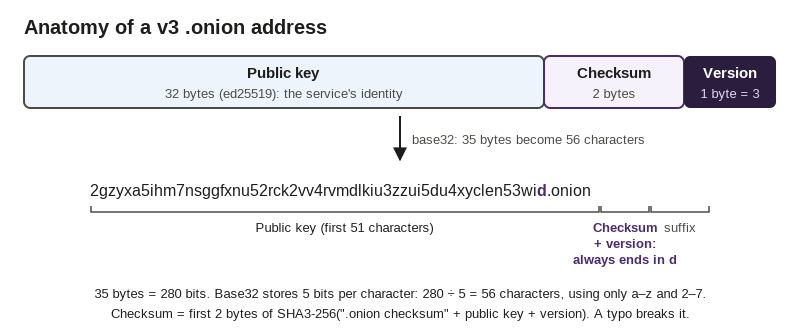
Tor's specification defines the address exactly: the service's 32-byte ed25519 public key, then a 2-byte checksum, then a 1-byte version number, all base32-encoded, followed by .onion.
- Public key (32 bytes, the first 51–52 characters). This is the service's identity. Whoever holds the matching private key runs the address.
- Checksum (2 bytes). The first two bytes of a SHA3-256 hash of the text “.onion checksum”, the public key and the version. Change almost any character by mistake and the checksum no longer matches, so Tor Browser cannot connect.
- Version (1 byte). Always 3 today. Because it sits at the very end, every v3 address ends in the letter d.
35 bytes is 280 bits, and base32 stores 5 bits per character, which is why there are exactly 56 characters. Base32 uses only the letters a–z and the digits 2–7, so 0, 1, 8 and 9 never appear in an onion address.
You can run all of these checks on any address, privately in your browser, with our onion address checker. Remember what the checksum does not do: it catches typos, not impostors. A scammer can create a different, perfectly valid address.
Why they look like that
Because the address contains the key, you do not need a certificate authority to know you reached the right site, as long as you have the right address. It also means addresses cannot be remembered or guessed easily.
Vanity addresses
Some organizations generate keys over and over until the address starts with a word, such as the CIA ("ciadotgov...") or DuckDuckGo ("duckduckgo..."). Tools such as mkp224o do this. Only the first few characters can be chosen; the rest stays random, which is exactly what copycats exploit.
Version 2 vs version 3
Older addresses had 16 characters. The Tor Project removed support for them in tor 0.4.6 in July 2021, and client releases from October 2021 disabled them. Today's addresses have 56 characters. If a list gives you 16-character addresses, it is out of date.
Subdomains
Like ordinary domains, onion addresses can have subdomains, so you will see addresses such as www. followed by the 56 characters. The service is identified by the 56-character part. Several sites in our list, such as DW, publish their address in that form.
Why you cannot just click one
A normal browser cannot resolve .onion. You need Tor Browser. Many sites tell Tor Browser about their onion address through an Onion-Location header, which makes a ".onion available" button appear. That header is how we verify addresses.
Fake and look-alike addresses
Because addresses are unreadable, scammers publish look-alikes that differ in a few characters from the real one. Paste one into a login form and you can hand your password to a copy. To protect yourself:
- Get the address from the organization's own site, a header it sends, or an official list like the Tor Project's.
- Bookmark it once you have verified it, and use the bookmark.
- Be suspicious of any directory that cannot say where it got an address. The Hidden Wiki is the classic example.
Where to find real ones
Start with our verified .onion links. Each says where it was checked. Want your own? See how to host an onion site.
Frequently asked questions
- How long is a .onion address?
- Current version 3 addresses are 56 characters before .onion. The old 16-character version 2 addresses stopped working in 2021.
- Why can't I open a .onion link in Chrome?
- Normal browsers cannot route to the Tor network. Use Tor Browser or another Tor-aware application.
- How do I know a .onion link is real?
- Get it from the organization's own site or from an official list, and bookmark it. Do not trust unsourced link lists.
- What is a vanity onion address?
- An address whose first characters spell a word, made by generating keys until the start matches. The rest of the address is still random.
- Why does every .onion address end in d?
- The last byte of a v3 address is the version number, 3. In base32 that final value is written as the letter d, so every valid v3 address ends in d.
- Can a .onion address contain 0, 1, 8 or 9?
- No. Onion addresses use base32, which has only the letters a to z and the digits 2 to 7.
Sources
Checked 23 November 2026. We cite primary sources wherever possible; see our editorial policy.
- Tor specification: Encoding onion addresses
- Tor Project: Understanding onion services in Tor Browser
- Tor Project blog: Onion service v2 deprecation timeline
- Tor Project: Onion-Location
- mkp224o vanity address generator (GitHub)
Related guides
- How onion services work
- The Hidden Wiki: what it is and why it is risky
- How to host an onion site
- Dark web safety guide
Looking for addresses? See our 50 verified .onion links, or check one with the onion address checker.