 DarkWebsite.link
Explainer
Dark web vs deep web
The deep web is everything search engines do not index, such as your inbox and bank account. The dark web is a small, deliberately hidden part of the internet that needs special software like Tor.
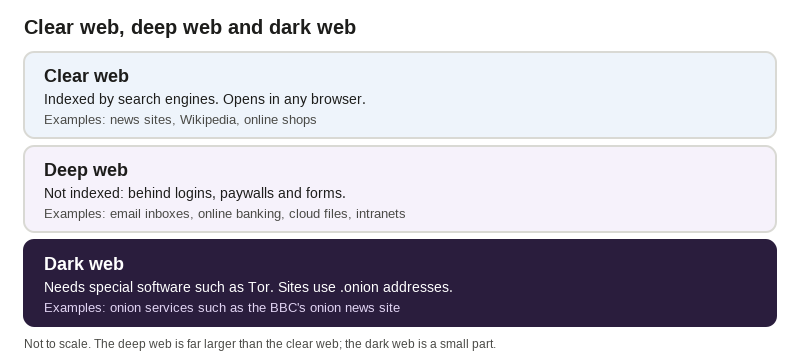
Three layers, one simple model
| Clear web | Deep web | Dark web | |
|---|---|---|---|
| Indexed by search engines | Yes | No | No (special search tools only) |
| Needs a login or special access | No | Usually a login | Special software such as Tor |
| Examples | News sites, Wikipedia, shops | Email inbox, banking, cloud files, company intranets, paywalled articles | .onion sites such as the BBC's onion service |
| Hides who runs it | No | No | Designed to |
The deep web is mostly ordinary
If a page is behind a password, a paywall or a form, a search engine cannot see it. That covers your medical records, your inbox and your company's internal systems. Nothing about this is secret or illegal. It is simply not public. The deep web is far larger than the visible web.
The dark web is a deliberate subset
Dark web sites are not just unindexed. They sit on networks like Tor that hide both ends of the connection. You need the right software to open them, which is why Tor Browser exists. Even dedicated dark web search engines only see the onion sites that someone has published.
Can you search the dark web?
Only partly. Google and other ordinary search engines do not index .onion sites, and version 3 onion services are designed so they cannot be listed from Tor's own directory. A dark web search engine can only find sites whose addresses have been published somewhere. Ahmia is the best-known filtered option; see dark web search engines.
Is the deep web dangerous?
No more than the rest of the internet. Your inbox and bank account are "deep web" simply because they are private, and the usual advice applies: strong, unique passwords and two-factor authentication. The dangers people associate with the "deep web" really belong to parts of the dark web, and even there the common ones are scams and malware rather than the network itself.
Where Tor, I2P and VPNs fit
- Tor is the best-known dark web network, and the one that uses .onion addresses. See what is Tor.
- I2P is a separate anonymous network with its own .i2p sites. See I2P vs Tor.
- A VPN hides your traffic from your local network but does not open onion sites. See Tor vs VPN.
Why the confusion matters
Articles that say "you use the deep web every day" are right, and articles that say "the deep web is full of crime" are wrong. Mixing the terms makes ordinary things sound dangerous. Use "deep web" for unindexed, "dark web" for hidden networks. More in dark web myths.
New to this? Read what the dark web is first.
Frequently asked questions
- Is the deep web illegal?
- No. The deep web is just content that search engines do not index, such as email, banking and private databases.
- Is the dark web part of the deep web?
- Yes, in the sense that dark web pages are not indexed by normal search engines. But it is a small, deliberately hidden subset that needs software like Tor.
Sources
Checked 23 November 2026. We cite primary sources wherever possible; see our editorial policy.
- Tor Project: Understanding onion services in Tor Browser
- Tor Project: About Tor (support)
- Ahmia: About
- I2P: Overview
Related guides
- What is the dark web?
- What is Tor and how does it work?
- Dark web myths, debunked
- Dark web search engines
Looking for addresses? See our 50 verified .onion links, or check one with the onion address checker.